
Neosho County Release Meanings
A Neosho County release is the end of one custodian's physical hold. It does not always mean the person is free of every case, sentence, or form of supervision. The Neosho County Jail can release a person after an executed bond, recognizance, a court order, dismissal with no other hold, time served, or sentence completion. A person may instead leave that jail for Kansas Department of Corrections custody, another county, the U.S. Marshals Service, or ICE. Those are transfers. Escape and death also remove a name from a custody list but are not ordinary community releases.
The record must answer four basic points: who left, which custodian released or transferred the person, when the event occurred, and what authority caused it. A county discharge entry answers those points for a local booking. KASPER, the Kansas corrections repository, covers a state sentence. The BOP locator covers sentenced federal custody. Court records show the legal case, but a judge's order does not prove staff completed the physical release or that every hold cleared.
Neosho County Release Types
The release authority controls the next search. Bond ends detention in that booking while the criminal case continues. Time served or sentence expiration may end a jail term but can leave probation or another sentence. Parole and postrelease supervision mean a person has left prison under KDOC control. A transfer keeps the person in custody under a new agency.
| Recorded event | Meaning | Best next source |
|---|---|---|
| Executed bond or recognizance | County detention ended; the case remains open | Jail discharge record and court docket |
| Time served or sentence completion | The recorded custody term was satisfied | Discharge record and sentencing case |
| Parole or postrelease | Prison custody ended under supervision | KASPER and the listed parole office |
| Transfer | Custody continued with another authority | The receiving agency's locator or records office |
| Dismissal | Release is possible only if no other hold remains | Court disposition plus jail confirmation |
Neosho County Discharge Record Fields
Kansas's permanent Jail/Commitment Record gives the strongest local historical route. The state retention description includes discharge date, time, and authority, along with property and money at commitment and release. A narrow request for the relevant fields is more useful than a broad demand for every file. Some identifiers can be redacted, and a booking photo should be requested as a separate item.
| Field | What it establishes |
|---|---|
| Name, aliases, birth data | Which person the record concerns |
| Booking or case number | The exact custody episode and court case |
| Admission date and authority | When and why the jail accepted custody |
| Bond and holds | Whether another condition could delay release |
| Discharge date and time | When the jail recorded the departure |
| Discharge authority or destination | Whether it was community release or transfer |
| Property and money at release | What the jail recorded as returned |
Request Neosho County Release Records
The sheriff's public pages do not expose a dedicated release-record form or named records custodian. Direct a focused Kansas Open Records Act request to Neosho County and ask that it be routed to the holder of the Jail/Commitment Record. The county's published form sets a $5 minimum for research and copying, $10 per hour after the first half-hour, and 25 cents per paper copy. Ask for an estimate and electronic delivery before work begins.
- Identify the person by full name, aliases, birth date if known, and the approximate booking date.
- Add the arresting agency, case number, or booking number when available.
- Request admission and discharge date and time, discharge authority, transfer destination, holds, bond execution data, and the booking image as a separate item.
- Ask for an advance fee estimate and the legal basis for each withheld or redacted field.
- Compare the response with the court or receiving custodian before treating the event as community release.
K.S.A. 45-218 calls for action as soon as possible and no later than the end of the third business day. That is a response deadline, not a promise that all copies will arrive then. The agency may explain a delay and give the earliest production date.
Neosho County Record Access Rules
K.S.A. 45-218 governs access procedures, while related KORA sections address fees, agency procedures, and exemptions. K.S.A. 45-217 excludes jail and detention rosters from the definition of criminal investigation records, but that rule does not erase privacy, safety, juvenile, sealed, or expungement limits. Kansas permanently retains the core county Jail/Commitment Record. Temporary-hold material can have a shorter schedule, so older peripheral records may not survive.
Expungement is a court process that can limit routine disclosure. Under K.S.A. 21-6614, the waiting period can run from sentence satisfaction or discharge from probation, parole, community corrections, or postrelease supervision. It does not always begin on the jail exit date. Eligibility depends on the offense and other facts.
Find Neosho County Released Inmates
Start with the last known custodian, not one universal name search. The official Neosho County Sheriff pages reviewed in July 2026 offered no current roster, release tab, 24-hour list, 72-hour list, archive, or photo gallery. A name missing from any current-only display remains ambiguous. Use this custody decision path:
- For a Neosho County Jail booking, call the jail and ask whether the event was release or transfer. Request the exact discharge date, time, authority, and destination.
- Test Kansas VINE for a matching Neosho County record. Read an event literally because transfer and escape are not community release.
- For a state sentence, search KASPER by KDOC number or name and match several identifiers.
- Check the Kansas court case for bond, disposition, sentence, probation, revocation, or satisfaction entries.
- Use BOP, ICE, or the federal docket only when the underlying custody was federal or immigration-related.
- When online results remain unclear, obtain the controlling custodian's release or transfer record.
A released person normally leaves a live jail roster. A transfer does too, so roster absence is never enough by itself.
KDOC Search for Neosho Releases
KASPER contains people sentenced to KDOC custody since 1980 who are incarcerated, supervised after prison, or discharged. Accept its disclaimer, search by KDOC number when possible, or use name plus advanced fields. Selecting Neosho as conviction county finds state cases from the county, not people physically housed there. A short county jail case may never appear.
| Search or result field | How to use it |
|---|---|
| KDOC number | Best exact state identifier |
| Name and alias | Starting point when the number is unknown |
| Birth and physical data | Separates people with similar names |
| Conviction county | Connects a state record to a Neosho case |
| Status | Distinguishes inmate, parole, discharged, absconder, and other categories |
| Anticipated release date | A changeable future estimate, not proof of release |
The KASPER search entry is shown below. Its controls help narrow the correct state record, but a county-only release still requires the jail or court route.
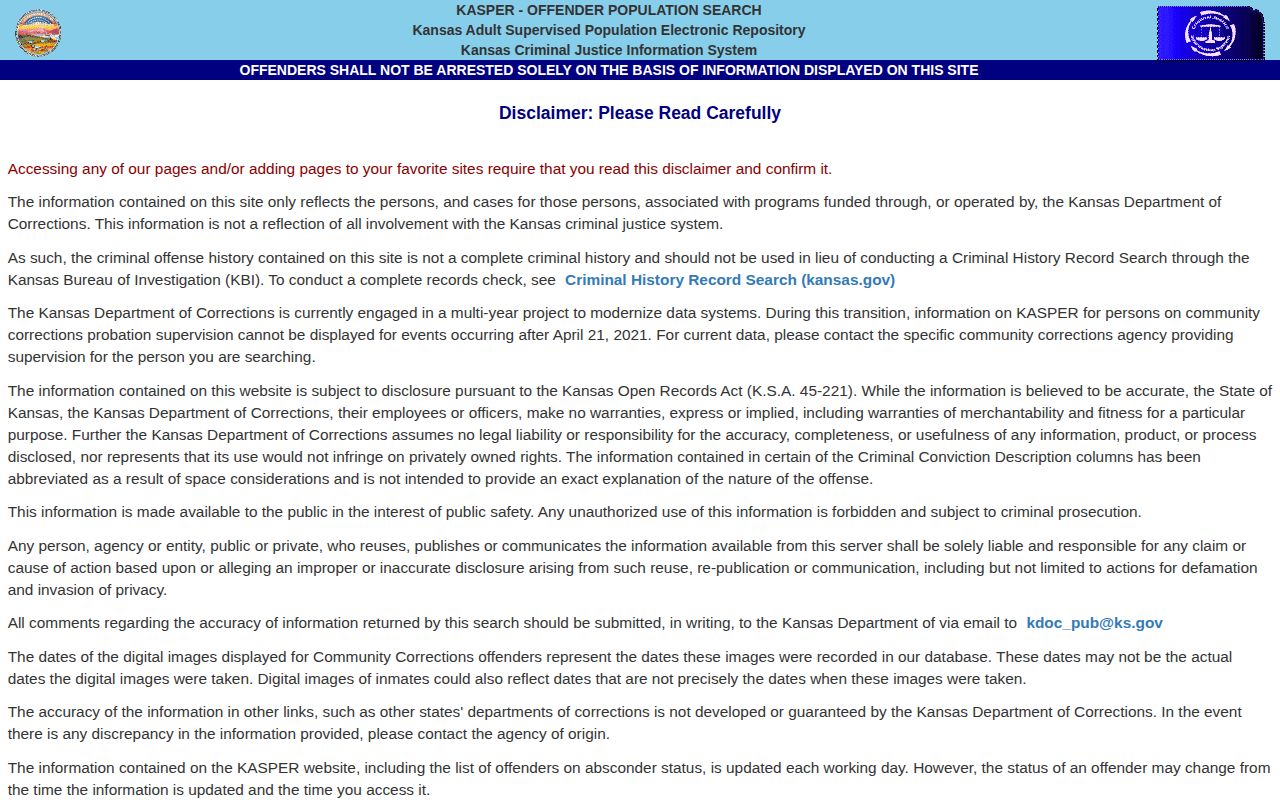
KASPER updates each working day rather than in real time. Read the status, movements, office, and dates together.
No Neosho Recent Release Feed
The official sheriff page and county sitemap exposed no recent-release feed or archive during the research sweep. CodeRED, the linked alert product, is for emergencies rather than inmate releases. For “who got out today” questions, use a named-person inquiry and request the discharge entry. The permanent state retention schedule provides more historical depth than the local website.
Neosho Post-Release Supervision Paths
Parole and postrelease supervision follow a Kansas prison term. Probation and community corrections can occur without prison. KASPER may show a state supervision office, but recent community-corrections probation events may be absent during system modernization. Neosho's local layers are distinct: Court Services and Community Corrections are in Chanute, while KDOC parole routes through the Pittsburg Parole Office. The Neosho County post-release supervision page explains how to verify the correct layer.
Neosho Release Alerts and Federal Records
Kansas VINE is intended for county jail custody changes, not KDOC prison cases. Confirm that Neosho appears in the live selector before relying on search or registration. BOP's locator can retain a “Released” status and date for sentenced federal custody. ICE's locator covers current detention and a short recent-release period. USMS has no equivalent public historical locator, so federal pretrial questions require the District of Kansas docket and a specific records request.
Match Neosho Release to Custodian
Each source proves only the event within its own system. Two compatible records provide better support than one isolated result.
| Situation | Source | Safe reading |
|---|---|---|
| County booking | Jail discharge record | Shows local release or transfer authority |
| Kansas prison sentence | KASPER | Inmate means custody; parole means supervised exit; discharged means sentence ended |
| Federal sentence | BOP locator | Released means no longer in BOP custody |
| Immigration detention | ICE ODLS | Current or recently ended ICE custody only |
| Federal pretrial case | Federal docket and USMS | Order plus custodian confirmation |
Neosho County Custody Routes
The Neosho County Jail is the only active local correctional facility verified in the official sweep. Municipal arrests in Chanute, Erie, St. Paul, and Thayer may lead there, while the municipal case stays with the proper city court. KDOC is a statewide system. BOP, ICE, and USMS are separate federal lanes, and none was identified as operating a dedicated Neosho County institution.
Neosho Release Property Records
The permanent Jail/Commitment Record includes property and money at release. That field can document what the jail recorded as returned. If it is wrong, contact the agency that created the entry. The sheriff can address a jail record, while an error in a judicial disposition belongs with the District Court clerk. One office cannot rewrite the other office's record.
Permanent Neosho Discharge Records
Kansas permanently retains the county Jail/Commitment Record, including the discharge date, time, and authority. That durable series remains the key historical path when Neosho County offers no public release archive. Temporary-hold files can follow a shorter retention rule, but the core commitment and discharge entry is not limited to a short online display window.
Neosho Release and Expungement Dates
The day a person leaves jail and the start of an expungement waiting period are not always the same. Kansas law can measure from later sentence satisfaction or discharge from probation, community corrections, parole, or postrelease supervision. A release entry therefore cannot establish expungement eligibility. Use the Judicial Branch self-help materials and the court's decision for that separate question.
ICE Release Records Near Neosho
ICE's Online Detainee Locator has a distinct recent-release window. It can cover someone released from ICE custody during the prior 60 days. Yet a departure from the Neosho County Jail may mark transfer into ICE custody, not release from it. No official source established an ICE contract facility in Neosho County, so the locator should be used only when immigration custody is known or supported by another record.
Neosho Release Court Record Split
Neosho criminal records have a local split. The Chanute Division keeps felony and misdemeanor criminal filings from 1955 and statutory bonds. Erie lists traffic, probate, warrants, and other categories. Municipal cases remain with the separate city courts. Search the statewide portal first, then contact the division that owns the filed record. A court trail can persist after a roster vanishes, but it must still be reconciled with VINE or the discharge record.
Transportation After a Neosho Release
SEK-CAP transportation provides demand-responsive public rides in Neosho County on weekdays from 7:30 a.m. to 3 p.m. Advance scheduling is advised, and same-day rides depend on availability. It is not a jail shuttle. Confirm the actual exit place and time with the jail before arranging a ride.
Neosho Release Counts Are Unpublished
The county's adopted budget separates sheriff, jail, dispatch, and juvenile-detention spending, but it gives no annual booking, release, average-stay, or turnover count. Those financial records show that jail operations are budgeted. They do not support an estimate of how many Neosho County inmates are released. No third-party figure should be substituted for an official count that was not found.
This gap also changes how a recent-release question should be framed. There is no sound total against which to test an online list, and no published cadence explains when a completed discharge might appear. A named record request is more defensible than trying to reconstruct a countywide count from scattered court cases. Court records describe legal events, not a full ledger of physical exits. KASPER omits short local cases, while federal locators cover only their own custodians. Each channel can confirm a particular person when it applies, but combining those channels cannot produce an official Neosho County release statistic.