
Neosho Federal Pretrial Routes
The U.S. Marshals Service controls many federal prisoners from a federal custody order until acquittal, court-ordered release, or delivery to BOP or another custodian. USMS often uses local or contract beds. Physical location does not change which agency controls the federal detention. Research did not identify a dedicated USMS facility in Neosho County, and this system page must not be read as proof of a local federal jail.
A person may leave the USMS network for the community under a court order, move to BOP after sentencing, or transfer to another authority. Delivery to BOP is continuing custody. An ICE handoff is also continuing custody. The destination and controlling authority are as important as the fact that one jail no longer holds the person.
Confirm a USMS Pretrial Release
USMS has no public historical inmate locator comparable to BOP’s. The federal docket is usually the clearest public starting point. Search for the defendant and case in PACER through the District of Kansas court-records route. Review detention orders, conditions of release, minute entries, judgments, and later custody-related filings. Use the case number to avoid same-name confusion.
- Identify the federal court and exact case number.
- Read the latest detention or release order in the docket.
- Check for a later order, hold, sentence, or revocation.
- Ask the controlling custodian whether the order was carried out.
- Use a focused USMS records request for missing historical facts.
A release order is legal authority, not an exact exit timestamp. Bond conditions, processing, transport, or another hold can affect the physical handoff. The Neosho County released-inmate guide explains the same order-versus-execution distinction for local custody.
District of Kansas Docket Search
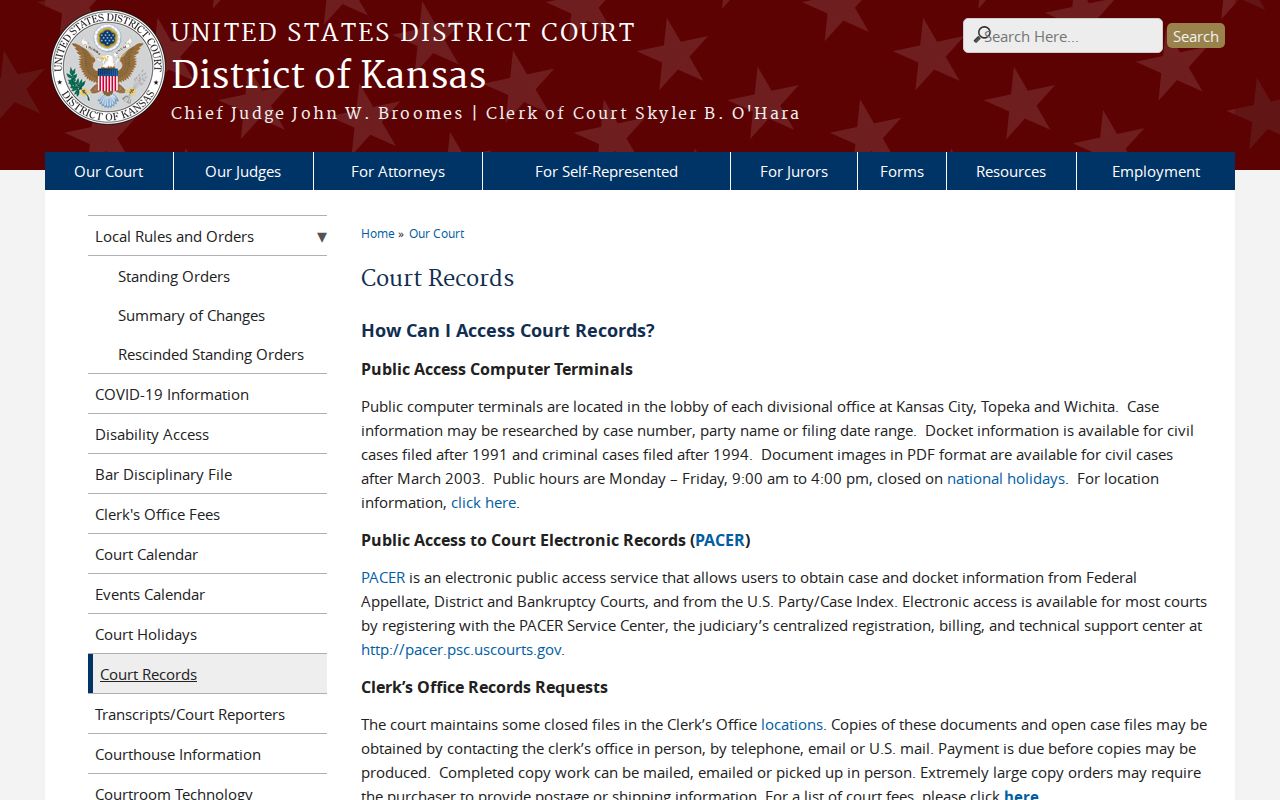
The District of Kansas provides PACER access and courthouse terminals. PACER is the federal judiciary’s electronic public-access system. A docket may show the initial appearance, detention hearing, bond or release conditions, revocation, plea, sentence, and judgment. Read entries in order because an older release order can be displaced by a later detention or revocation order.
The official District of Kansas records page explains those access routes. The page-matched capture below is the successful manifest image assigned to all three federal system pages.
Courthouse access or a clerk inquiry can help when a document is not available online. The docket is strongest for the legal case. USMS or the actual physical custodian remains the better source for whether and when the person physically left custody.
USMS Records and Contact Route
This page represents a national prisoner network, not a Neosho County building. The official USMS Freedom of Information Act page is the formal route for agency records. USMS prisoner and warrant files may be subject to exemptions and fees. Identify the person, federal case number, district, approximate custody dates, and the specific release or transfer fact requested. Broad requests can sweep in protected law-enforcement details and take longer to process.
U.S. Marshals Service prisoner network
Court access: District of Kansas records
Records requests: USMS FOIA
Sentenced custody: BOP release lookup
Ask for the custody disposition and destination rather than a broad movement history. Public access can be restricted for safety and law-enforcement reasons. A denial or redaction should be described as withheld information, not proof that no record exists.
Local Beds, Federal Custody
A federal prisoner can be housed in a county or contract jail while USMS retains legal control. That arrangement can confuse searches. The person may appear in a local custody system, yet the federal court and USMS determine the federal detention. Leaving the local bed for another USMS placement is a transfer, not release to the community.
If Neosho County Jail was the last known physical location, request its discharge date, time, authority, and destination. The county record can document the local handoff. It cannot decide whether USMS later released the person. No reviewed source established that Neosho County routinely houses USMS prisoners, so this is a verification route, not a claim about a local contract.
USMS also restricts public release of prisoner photographs, histories, and movement times. Do not promise a photo or detailed route. The federal docket, a narrow records request, and direct custodian confirmation form the practical fallback chain.
After Neosho Federal Detention
Sentencing can move a person from USMS control into BOP custody. The BOP Inmate Locator may then become useful, but a gap before designation does not prove release. BOP’s public system covers sentenced federal custody and records from 1982 forward. A pretrial person who never entered a BOP sentence may have no BOP result at all.
Acquittal or a release order may lead to the community if no other hold exists. Another county, state, or ICE agency may instead take custody. Check the federal docket for the legal event and the receiving agency for the handoff. For immigration detention, use the ICE detainee release route. For a Kansas sentence, KASPER is the state source, though a federal court connection alone does not create a KDOC record.
ICE Custody After USMS Transfer
Research Section 19’s facility angle applies when immigration custody follows a federal or local handoff. ICE ODLS includes current detainees and people released from ICE custody during the prior 60 days. If USMS delivered the person to ICE, the end of USMS custody and the later ICE release are distinct events. Search each separately.
No official evidence established an ICE contract facility in Neosho County. The short ODLS window is useful only after there is a reason to believe ICE became the custodian. After that window, use ICE records or immigration case channels. A missing ODLS result cannot be used to infer a particular release outcome.
Separate Neosho Federal Systems
USMS answers the pretrial-custody question. BOP answers the sentenced-federal-custody question. ICE answers the civil immigration-detention question. Neosho County records a county booking, and KDOC records a Kansas sentence. None is a universal custody clearance.
Match identity through the federal case number, federal identifier when one exists, full name, date of birth, and custody dates. Record the source and check date. Phrase the conclusion narrowly: a docket shows an order; a custodian confirms an exit; a receiving agency confirms later custody. That method preserves the difference between release and transfer while providing a defensible route through a system with no public USMS historical locator.
When a Release Order Executes
A docket time stamp records when the court filed an order, not necessarily when detention staff completed the release. Conditions may need review, a bond may need execution, and another authority may have a valid hold. Check later docket entries for modification or revocation. Then ask the custodian whether the person left for the community or was transferred.
For a precise request, state the order date and case number and ask for the releasable custody disposition linked to that order. If an exact time is not maintained or is withheld, report that limitation. Do not replace it with the electronic filing time. The legal event and the physical event can occur on the same day yet still be different records.
Match a Federal Pretrial Record
Use the federal case number as the primary key. Add the full name, aliases, date of birth, arrest date, district, and any USMS or BOP number that appears in official material. Name-only matching is weak, and a BOP search is not a reliable substitute for a USMS record. A person released before sentence may never appear in the BOP locator.
Historical searches should preserve the docket entry, retrieval date, and agency response. Sealing, redaction, exemptions, and later docket action can narrow public access. A blank public search therefore cannot prove that no detention occurred. Positive, identity-matched court and custodian records carry more weight. When facts conflict, ask which event each source records before deciding that either source is wrong.