
Neosho Projected and Actual Release
KDOC uses the exact term anticipated release date. It is an estimate derived from the sentence and credits then recorded. It does not certify that a person left prison. Actual release requires a later movement, a released or supervised status, or the discharge entry created when custody changed.
A pretrial Neosho County Jail detainee usually has no computed sentence-ending date. A judge may authorize bond, but the person remains held until bond is executed and all other holds are cleared. A transfer to KDOC, another county, USMS, or ICE is also not community release.
County and state records answer different questions. KASPER covers people sentenced to KDOC custody since 1980. A short local sentence, dismissal, or local bond release may never appear there. The Neosho jail record and court file are the right sources for those cases.
Find a Neosho Release Date
First identify whether the person is in county, state, or federal custody. A conviction in Neosho County does not mean the person is physically housed there. KASPER can filter by conviction county while showing a state facility elsewhere.
- For a KDOC case, accept the KASPER disclaimer and search by KDOC number or name.
- Use advanced fields such as Neosho conviction county, alias, birth data, location, or supervision type to narrow the result.
- Open the record and compare several identifiers. Read the status, movements, and anticipated release date together.
- For a county-jail sentence, obtain the commitment and sentencing order, credited confinement time, local calculation, and final discharge entry.
- For a pending case, inspect the Kansas court portal, then confirm any release order with the jail because the order alone does not prove exit.
The Neosho County released-inmate search explains the full county discharge-record request. A focused request should identify the person, booking or case number, and approximate custody dates.
The public KASPER search controls are visible in the KDOC offender search shown below.
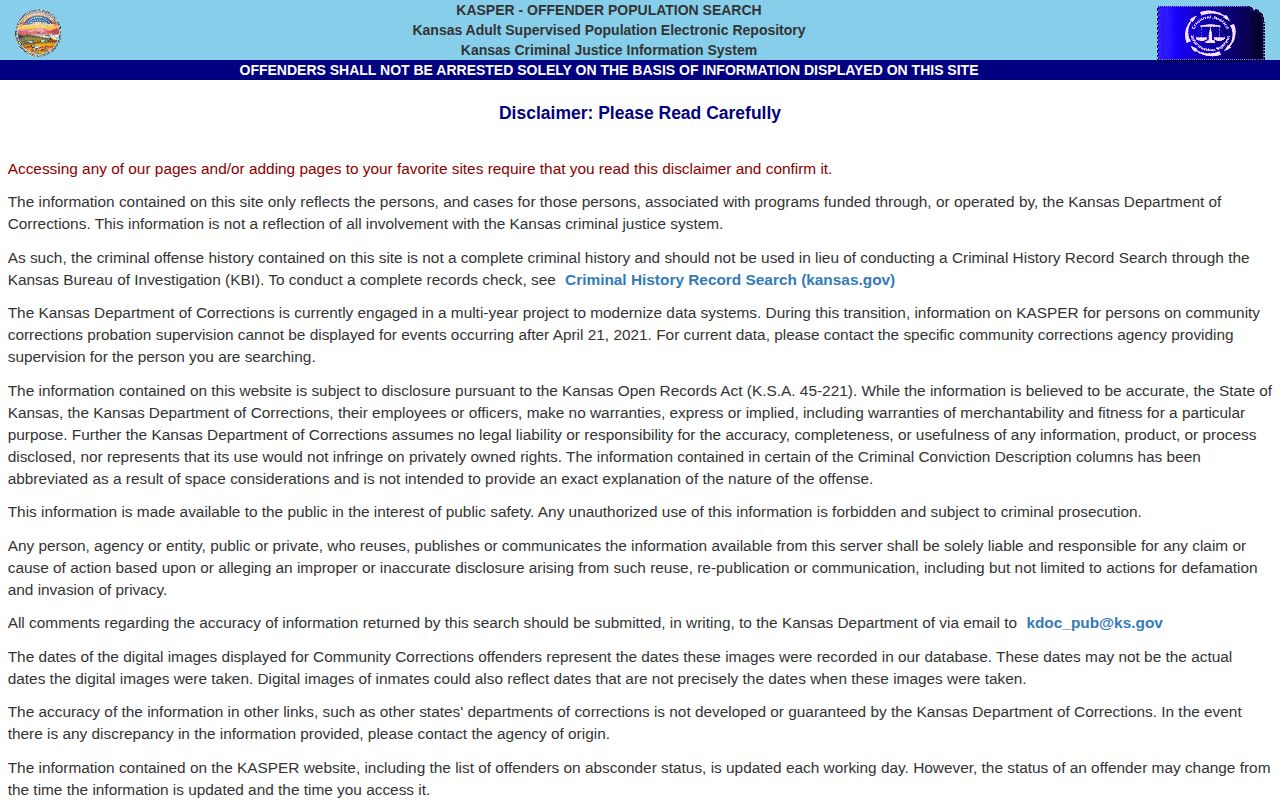
Its fields help separate a Neosho conviction from the person's current location and status.
Neosho Release Credits Under Kansas Law
A sentence calculation can include the start date, jail or residential credit, concurrent or consecutive terms, good time, eligible program credit, mandatory minimums, discipline, and later sentence changes. Concurrent terms run together to the extent ordered. Consecutive terms run one after another. A mandatory minimum limits how soon release can occur.
K.S.A. 21-6821 generally caps good time at 15 percent of the prison portion for crimes committed on or after July 1, 1993. That creates the “about 85 percent” shorthand, but the rule is not universal. The statute allows up to 20 percent for specified lower-severity drug and nondrug categories based on offense date. Off-grid and mandatory-minimum rules can restrict credit.
Good time must be earned and can be forfeited. K.S.A. 21-6615 governs sentence commencement and confinement or residential credit. Older pre-July 1993 indeterminate terms follow a different framework. Their parole eligibility and conditional release calculations should not be forced into the modern percentage shorthand.
The official statute page below states the Kansas good-time framework.
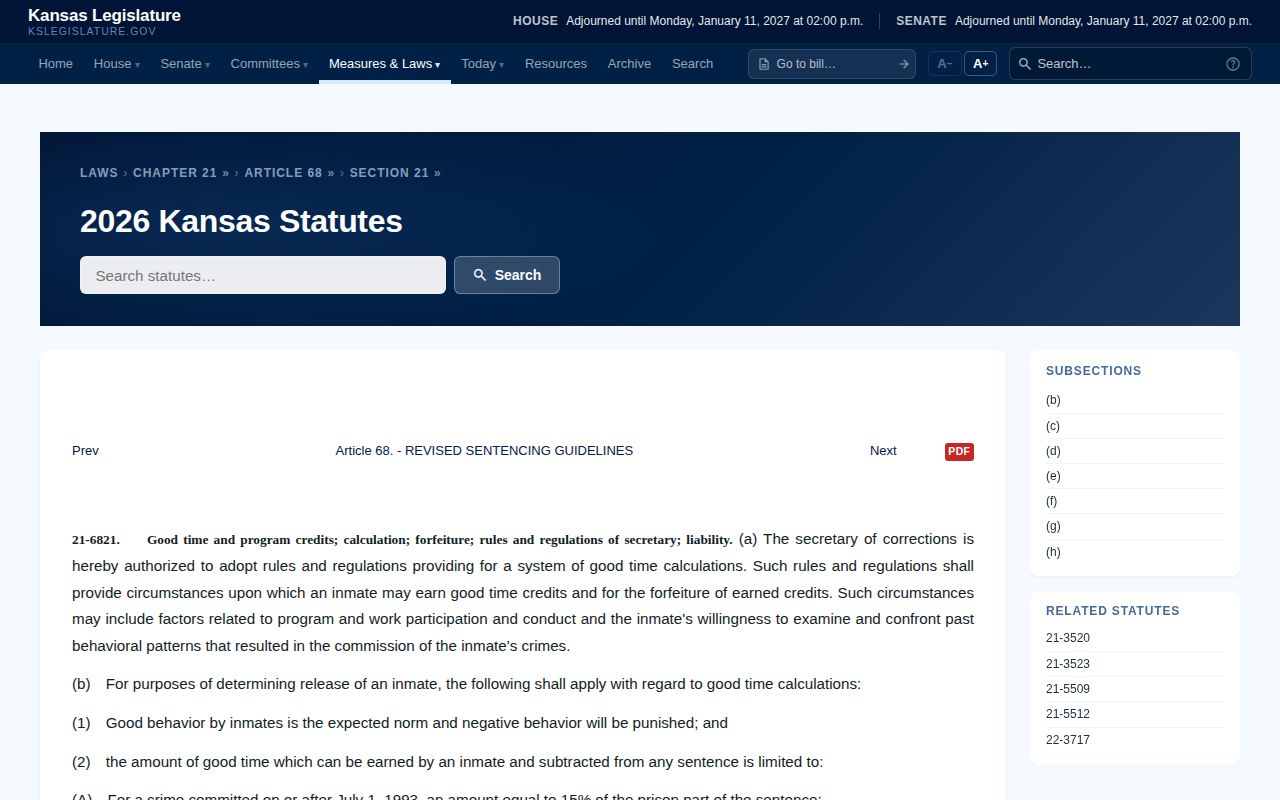
The governing percentage depends on the sentence, offense date, and category, so the individual KDOC computation remains controlling.
Why Neosho Release Dates Change
An anticipated date is a live calculation. New credits may move it earlier, while forfeiture or a new legal restraint may move the practical exit later. Some events change only where custody continues, not the sentence itself.
| Factor | Possible effect | Where to verify |
|---|---|---|
| Good time earned or lost | Changes the administrative credit applied to the prison term. | KDOC record and Sentence Computation |
| Program credit | May alter the estimate when the sentence is eligible. | KDOC |
| Jail or residential credit | Changes credited time before or during the term. | Court order and computation |
| Consecutive sentence | Adds another term that must be served in sequence. | Sentencing docket and KDOC |
| Detainer or hold | May cause transfer or continued custody after one term ends. | Holding agencies |
| Later court order | Can amend, vacate, or otherwise alter the sentence. | District Court record |
| Parole decision | Eligibility does not assure a grant; a pass or continuance changes expectations. | Prisoner Review Board and KASPER |
KDOC's locating guidance says anticipated dates can change with good-time and program-credit earnings or forfeitures. Sentence Computation handles date questions at 785-296-3317. An email correction request is not an immediate status change.
Confirm Neosho County Release Dates
For KDOC, return to KASPER after the anticipated date and inspect the status and movements. Parole or postrelease supervision means prison custody ended while KDOC control continues. Discharged is the clearest category for an ended KDOC sentence. Deceased and Discharged-Deceased require literal wording.
For Neosho County Jail, request the exact discharge date, time, authority, and destination. Kansas's permanent Jail/Commitment Record can contain those fields. It can also show bond, case, property, and money-at-release data. A current-only roster is not a release archive.
VINE may help with a county-jail custody change only when the live system confirms Neosho participation. Research did not establish a Neosho feed, and Kansas VINE does not cover KDOC prisoners. The VINE Inmate Check begins with that availability test.
Neosho County Jail Computations
Do not apply the KDOC percentage formula to a county-jail term. The local answer depends on the sentencing order, time already credited, the county's calculation, and any other case or hold. A person can finish one local term and still transfer to another custodian.
The Neosho court trail can show sentence, probation, revocation, bond, and later disposition entries. Yet a judicial order authorizing release does not prove that jail staff executed it. Bond may remain unposted, and another hold may block departure.
Ask the jail for the final discharge entry after the expected date. Request the discharge authority and destination as well as the time. Those fields distinguish release to the community from a transfer to KDOC, another county, USMS, or ICE.
Neosho KASPER Date Labels
KASPER's status and date labels should be kept distinct. Anticipated release date is forward-looking. Facility movement shows a custody event. Parole describes supervised community status. Discharged describes the end of the KDOC sentence.
The KDOC locating FAQ shown below explains the state's offender-location and date context.

Use the exact label in any records note. That small step prevents an estimate from being repeated as a completed release.
Neosho Sentence Types Change Dates
Sentence structure matters before any credit is applied. A determinate sentence states a fixed prison term and commonly leads to postrelease supervision. An older indeterminate sentence uses a minimum and maximum framework, with parole eligibility and conditional release concepts. A life or off-grid sentence can carry rules that do not fit either a simple percentage or an ordinary calendar estimate.
Modern determinate sentences do not all require a discretionary parole hearing. The Prisoner Review Board is especially important for older indeterminate and certain life or off-grid cases. Its public-comment lists are upcoming-event calendars, not release lists. Appearance on a list means a hearing or comment event is scheduled, not that parole was granted.
K.S.A. 22-3717 contains parole eligibility, conditional release, and postrelease rules with many offense-date and sentence exceptions. The controlling judgment and KDOC computation must be read together. A broad summary cannot settle one person's date.
Neosho Release Status Afterward
When the expected date passes, the next status shows what happened. Parole or postrelease means the person left prison but remains supervised. Discharged means the KDOC sentence ended. A movement to another facility means custody continued. Absconder concerns contact or compliance during supervision and does not itself establish a new crime.
Federal dates require a different search. The Bureau of Prisons Locator can show Released and a release date for sentenced federal custody. That means no longer in BOP custody, not necessarily free of supervision or another custodian. USMS pretrial custody has no comparable public historical locator. ICE's locator concerns immigration detention and a short recent-release window. None should replace the Neosho jail record.
A county-jail departure can be a transfer into any of those systems. Ask for destination and authority. If the discharge record says KDOC, USMS, ICE, or another county, do not call the event community release merely because the person vanished from a local view.
Correct Neosho Release Date Errors
KDOC directs sentence-date questions to Sentence Computation. A person who finds a KASPER accuracy problem may submit a written correction request to kdoc_pub@ks.gov. The request should identify the exact record and disputed field, explain the claimed error, and cite the court or agency document that supports a correction.
An email does not change the public status at once. Keep the original source, submission date, and any response. If the alleged error comes from the sentencing judgment, the District Court clerk is the correct source for the filed order. KDOC cannot rewrite a court judgment, and the sheriff cannot alter it.
For a county discharge error, contact the Neosho custodian that created the Jail/Commitment Record. Request the exact entry rather than relying on a verbal estimate. This keeps a calculation question separate from the final recorded custody event.