
Where KDOC Releases Go
KDOC holds people sentenced to the Secretary of Corrections and supervises many after prison. A person may leave a prison for parole or postrelease supervision while remaining under KDOC control. “Discharged” is different: it is the clearest public KASPER category for an ended KDOC sentence. Neither status proves that every separate county, federal, or immigration matter has ended.
A transfer from Neosho County Jail into KDOC begins or continues state custody. It must not be described as a community release. Conversely, a person released after a short county term, local bond, or dismissal may never appear in KDOC’s repository. Classify the custodian before searching.
Confirm a Kansas Corrections Release
Open KASPER, accept its disclaimer, and search by KDOC number when known. Otherwise use name and advanced fields. Select Neosho as conviction county only when the state case arose there. Turn on photographs when needed to separate similar identities. The Neosho County release guide explains when to return to county records.
- Match the KDOC number, birth data, physical description, photograph, conviction county, and case.
- Read the current status and supervision level.
- Review movements, location, and supervising office.
- Separate the anticipated release date from an actual movement or status.
- Ask KDOC to resolve conflicts rather than guessing from one field.
KASPER is updated each working day, not in real time. “Parole” and post-incarceration supervision support prison exit with continuing control. “Inmate” means custody continues. “Absconder” concerns alleged loss of contact or noncompliance and does not itself prove a new conviction or active warrant.
KDOC Records and Contact
KASPER: Kansas Adult Supervised Population Electronic Repository, the statewide public search for KDOC custody, post-incarceration supervision, and discharge records. Written accuracy concerns may be sent to kdoc_pub@ks.gov. Sentence Computation handles a particular anticipated-date question at 785-296-3317 when the KDOC number is available.
Pittsburg Parole Office: 1008 W. 4th Street, Pittsburg, KS 66762; 620-232-9550. It serves Neosho County and neighboring counties, but geography alone does not prove an individual reports there. Read the KASPER supervision office and verify identity before contacting an office.
KASPER public records can include identifiers, photographs, convictions and cases, facility movements, location, supervision level, supervising office, and anticipated release date. A written correction request does not instantly change a public status.
About the Kansas Corrections System
KDOC is a statewide network rather than a Neosho County building. No state prison was identified within Neosho County in the reviewed official sources. KASPER covers people sentenced to KDOC custody since 1980 who are incarcerated, supervised after imprisonment, or discharged. Public names generally remain unless the conviction is removed through reversal, expungement, or executive clemency.
Someone convicted in Neosho County may be housed elsewhere and still be found with the conviction-county filter. Someone physically held in the county jail may have no KDOC number at all. This boundary prevents a statewide prison locator from being presented as a county jail roster.
The official KASPER disclaimer and search entry shows the public gateway used before searching KDOC records.
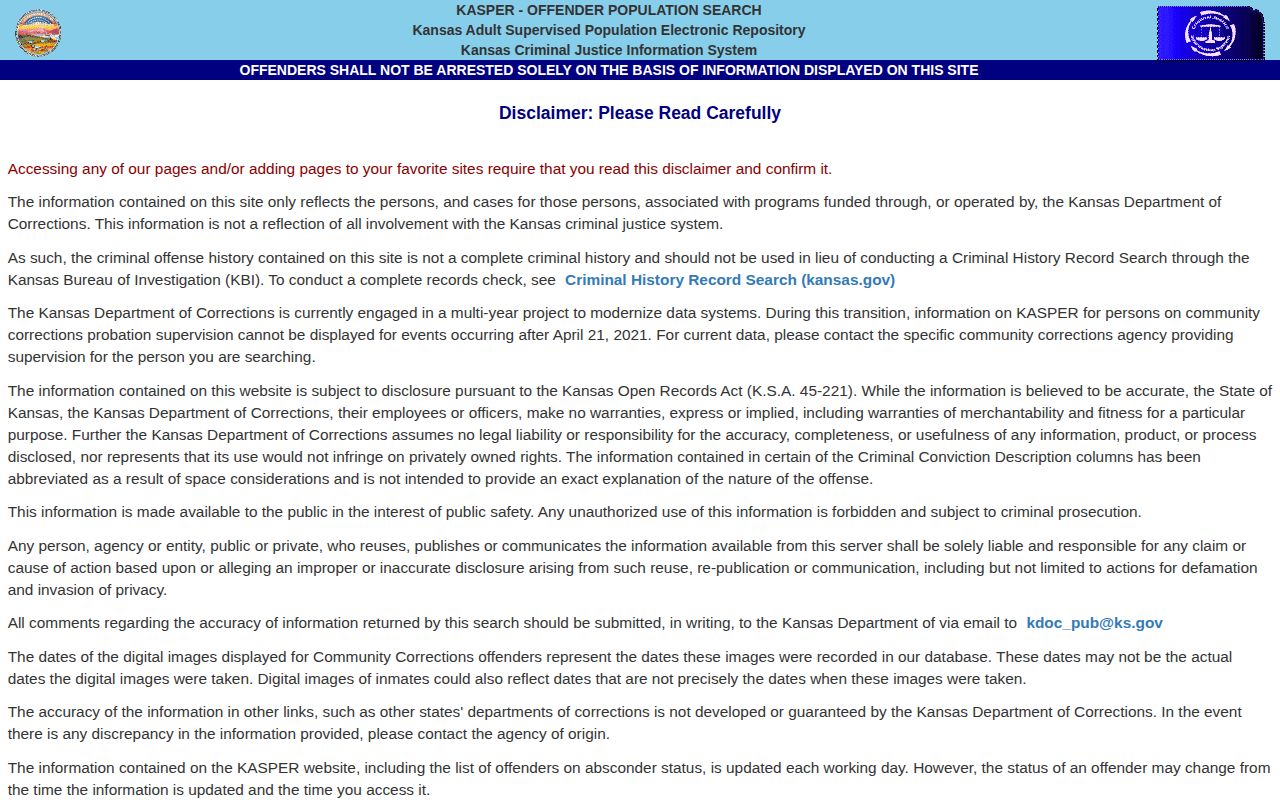
The captured entry is a statewide corrections source. It should not be read as a Neosho County jail roster or as proof of a particular person’s status.
Read KASPER Status Carefully
“Discharged” most clearly indicates completion of the KDOC sentence shown. “Parole” and other post-incarceration supervision levels indicate prison exit with continuing correctional control. “Deceased” and “Discharged-Deceased” require exact wording. An absconder entry concerns supervision compliance or contact, not proof of a new offense. KASPER also warns that community-corrections probation events after April 21, 2021 may not display during modernization.
Check multiple fields because one label rarely tells the whole story. A movement to a parole office strengthens a supervision interpretation. A discharge status may coexist with an unrelated case elsewhere. For local probation, contact Court Services or Community Corrections because KASPER is not a complete probation ledger.
KDOC Anticipated Release Dates
KDOC labels its future field “Anticipated release date.” It can change through good-time or program-credit earnings and forfeitures, sentence recalculation, consecutive matters, new judicial action, or data refresh. It is not proof that release occurred. Confirm an actual event through a later movement, parole or discharge status, supervising office, or KDOC computation.
Do not confuse anticipated release with parole eligibility, conditional release, or a hearing date. Preserve the KDOC number and the date the record was viewed when asking Sentence Computation to resolve a discrepancy. Current status controls the public description until KDOC corrects it.
Neosho Cases and Supervision
Parole and postrelease supervision follow state imprisonment. Probation and community corrections may occur without prison. For KDOC supervision, search KASPER and use the office displayed on the person’s record. The Pittsburg office serves Neosho County, but its service map is not person-level proof.
The court record can explain the sentence or later revocation, while KASPER shows the corrections status. These sources record different events. Reconcile them when dates appear inconsistent rather than choosing whichever result seems newer.
ICE Transfer or Recent Release
ICE’s Online Detainee Locator has a distinctive short window: it can include people currently detained and people released from ICE custody during the prior 60 days. That can help after a verified immigration-custody event. Yet a person leaving Neosho County Jail for ICE has transferred into another form of detention, not entered the community.
No official source reviewed for this project established a Neosho County ICE contract facility. Do not infer an immigration hold from a missing name. First establish the county discharge or transfer and its destination. Only then use ICE’s locator or records channels to answer the separate federal custody question.
KDOC Release Law and Credits
Kansas release calculations depend on the sentence and the law that applies to it. Good-time rules, jail credit, consecutive cases, conditional-release provisions, forfeitures, and later court action can affect the projected date. K.S.A. 21-6821 supplies a good-time framework for covered sentences, while K.S.A. 21-6615 addresses jail-time and other sentence credits. K.S.A. 22-3717 covers parole eligibility, conditional release, and postrelease rules. None of those statutes can be reduced to one formula without the sentence record.
Use KASPER’s date as the public starting point, not a personal recalculation. If the displayed date conflicts with a known sentence event, collect the KDOC number, case numbers, viewed date, and relevant court order before contacting Sentence Computation. Credits can be earned, withheld, forfeited, restored, or recalculated under the applicable rules. A later actual status or movement can supersede an older captured estimate.
KDOC Records After Discharge
KASPER can preserve a public trail after custody and supervision end. That persistence helps distinguish a past KDOC sentence from a current county booking. It does not mean every state record remains public forever. Reversal, expungement, and executive clemency can affect public display, and restricted fields do not become open merely because a name appears.
A person challenging KASPER accuracy may write to KDOC with enough identity and case detail to locate the entry. The source office should review its own record. A corrections agency cannot rewrite a judicial disposition, so an alleged docket error belongs with the court. Likewise, a county booking correction belongs with the county custodian. Keeping those responsibilities separate prevents conflicting corrections from being sent to an office with no authority to act.
ICE Status After KDOC Custody
ICE ODLS may include people currently detained and those released from ICE custody within the prior 60 days. That short recent-release feature is useful only after an immigration-custody event has been established. A person leaving KDOC for ICE has transferred between custodians and has not yet been shown as released to the community.
No official evidence established an ICE contract facility in Neosho County. Do not infer ICE involvement from a blank KASPER result or a movement that lacks a destination. Confirm the KDOC exit first, then search the federal system with the identifiers it requires. After the recent ODLS window closes, use the proper ICE case or records channel rather than assigning an unsupported outcome.